Taking a Stand

Working with human rights in Arla

Working with human rights in Arla

We embed our commitment to respect human rights in all business areas and processes, through our Code of Conduct, our Code of Conduct for Suppliers and Business Partners and other exterinternal policies. We establish processes that enable us to identifyprevent and mitigate potential adverse human rights impacts that we may cause, contribute or be directly linked to through our business activities. If we find that we have caused or contributed to adverse impact, we provide remediation appropriate to the grievance. If we find that we are directly linked to adverse impact, we will use our leverage to seek to prevent or mitigate adverse human rights impact.

Read our Human Rights Policy

2024-2026: embedding human rights and governance​

In 2024, Arla's human rights work focused increasingly on regulatory readiness and strengthened governance. A human rights check was made in Nigeria, and that same year, Arla’s published its first Modern Slavery Statement (Canada) was published

In 2025,  Arla updated its salient human rights risks in a business setting, ensuring alignment between human rights priorities, operational realities, and risk-based decision-making.

In 2026, Arla updated its Code of Conduct, further embedding human rights, ethical standards and responsible business expectations across the organisation

2024-2026: embedding  human rights and governance​

2021-2023: growth and value creation

In 2021, Arla continued to strengthen the link between human rights, decent work, and sustainable agricultural development.
The Pilot Organic Dairy Farming was launched in Indonesia to support local farmer capabilities and sustainable production practices.

The same year, housing facilities for migrant workers in the Middle East met the International Labour Organization (ILO) standards, reinforcing Arla's commitment to decent living conditions.

In 2022, we conducted human rights checks in Bahrain, Qatar, and Saudi Arabia. 

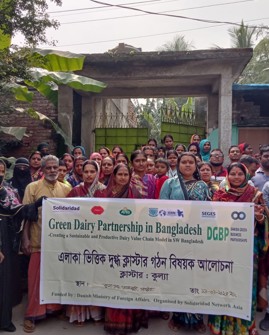
In 2023, The Green Dairy Partnership was launched in Bangladesh to strengthen local farmer capabilities.

In Nigeria, the inauguration of an Arla dairy farm represented a further step in market engagement and local value creation.

Human Rights Assessments in Senegal and Ghana were conducted.

2021-2023: growth and value creation

2018-2020: impact and partnerships

In 2019, Arla increased the focus on partnerships and tangible impact. The Pushti ambassador programme was launched in Bangladesh, employing female entrepreneurs for last mile distribution of dairy products. Arla also strengthened its engagement with smallholder farmers and signed a memorandum of understanding with Kaduna State Government in Nigeria, supporting the DAMAU Households project aimed at improving livelihoods by settling 1000 farmers with 3000 imported cows.

That year Arla also collaborated with the Danish Institute for Human Rights and held a Human Rights Dialogue Forum, and conducted a human rights assessment in Bahrain.  

In 2020, we further embedded human rights into our company polices and risk-based approach. A Parental leave policy aligned with ILO principles was introduced, reinforcing Arla’s commitment to decent work. The company also defined its salient human rights risks, focusing strategically on the most severe risks in its value chain.
Human rights assessments were conducted in Nigeria, Ghana and Senegal.

2018-2020: impact and partnerships

2015-2017: integration

2015 Marked a change in Arla’s human rights maturity journey.

That year Arla developed human rights due diligence and assessment processes in compliance with UN Guiding Principles, in collaboration with Danish Institute for Human Rights. The same year Arla published its global Human Rights Policy, an updated Code of Conduct and human rights assessments for Nigeria and Senegal.

In 2016, Arla introduced an anti-harassment/non-discrimination policy and expanded its human rights due diligence through assessments in Bangladesh, the Democratic Republic of Congo, Egypt, Indonesia and Ghana. 

In 2017, Arla published its first UK Modern Slavery Statement, in line with emerging regulatory expectations. At the same time, a human rights assessment on scaling-up affordable dairy nutrition in Bangladesh was published, and human rights assessments were conducted in Indonesia and Ghana.

2015-2017: integration

2008-2014: foundation and commitment

2008 marked the beginning for Arla’s structured approach to human rights, diversity and responsible business conduct.
That year Arla became a participant of the UN Global Compact and published its first Code of Conduct. 

In 2009, Arla began building insight into human rights risks in its supply chain.
The assessment and monitoring of human rights risks in the global south, marked an early move toward risk-based human rights due diligence.

In 2010, Arla strengthened focus on global work with diversity and inclusion, and in the same year, CEO Peder Tuborgh formally endorsed the UN’s Women’s Empowerment Principles, signaling leadership-level commitment to gender equality.

In 2011, Arla introduced its Diversity strategy, further strengthening its commitment to equality and inclusion.

In 2012, Arla established a global whistleblower service, strengthening mechanisms for reporting and addressing concerns. The same year Arla began employing women in its business in Saudi Arabia. This included hiring female colleagues for the Danya site and market research in Riyadh.

In 2014, Arla extends its expectations on responsible conduct in the value chain. The first Code of Conduct for Suppliers was published including human rights and ethical standards more clearly in supplier relationships.

2008-2014: foundation and commitment

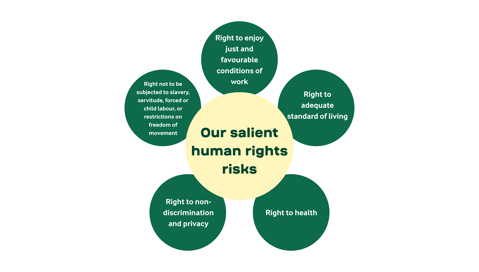
Salient human rights risks in a business setting

Through our due diligence, risk assessments and stakeholder dialogue, we have identified the following salient human rights issues. These issues were reviewed in 2025, and as a result the right to non-discrimination and privacy was included.

Salient human rights risks in a business setting
Child on a swing

HUMAN RIGHTS IMPACT ASSESSMENTS

We assess human rights impacts in the countries where we operate. 

Country summaries

Here we present summaries of findings per country:

GHANA INDONESIA


In-depth assessments

Here we present some of the most critical topics to ensure we respect and promote human rights throughout our operations: 

BANGLADESH NIGERIA SENEGAL