Arla's Climate Ambition
Climate change is one of the greatest challenges the world is facing today. In order to limit global warming to 1.5 degrees, significant action is necessary.
As one of the world’s largest dairy producers, we have a responsibility to do our part in reducing our negative impact on the climate. With our size comes strength and influence. Even by making small changes we have the power to make a significant global impact.
By building on our cooperative roots, we unite our resources and use them as a force to drive down emissions while producing nutrient dense products for the growing population.
Working together towards Carbon Net Zero dairy in 2050
Together with our farmer owners across seven European countries we launched our ambitious climate target in March 2019. Our ambition is to become carbon net zero by 2050.
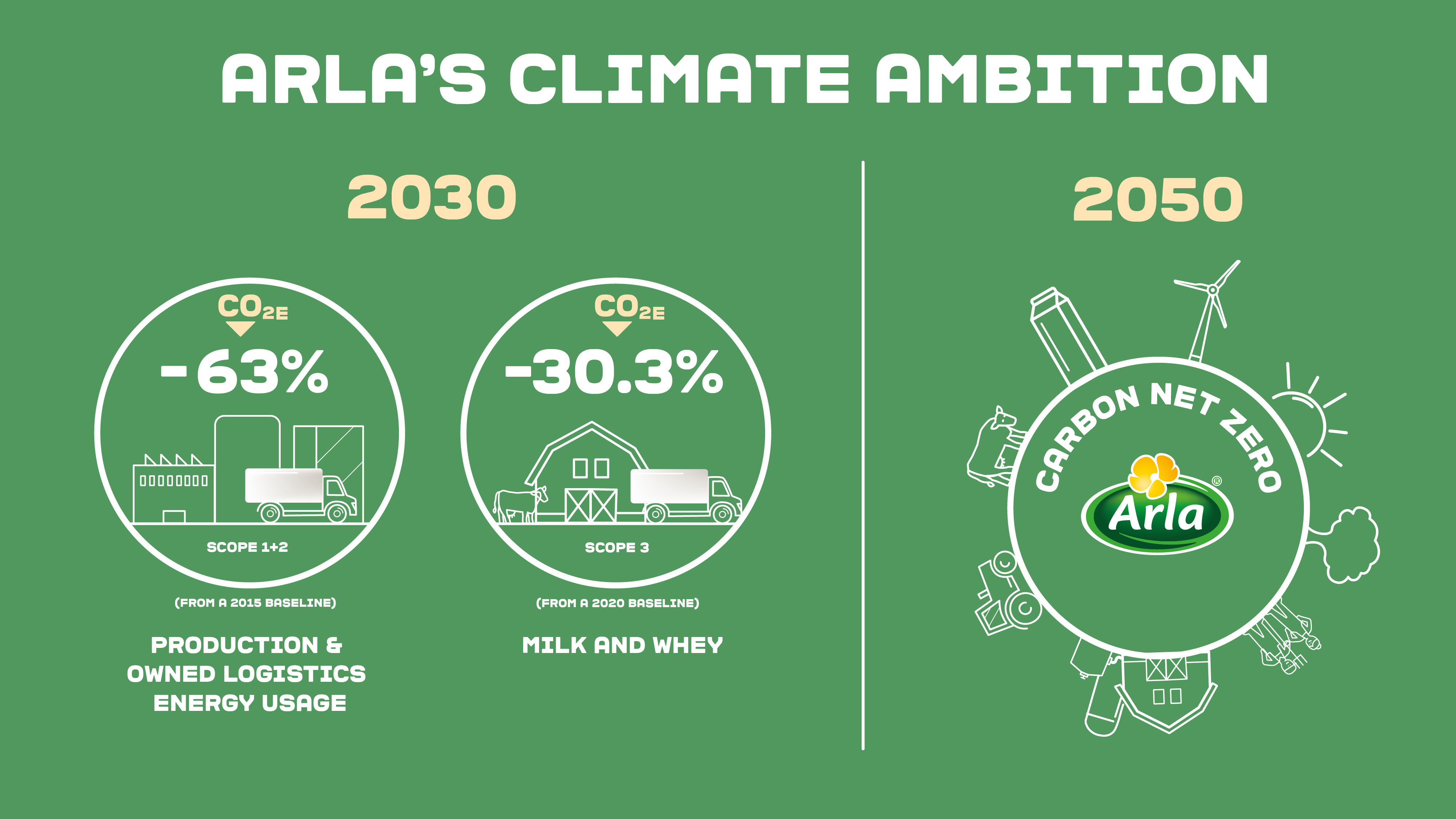
On the way to net zero emissions, we have committed to reduce absolute scope 1 and 2 greenhouse gas emissions by 63 per cent by 2030 from a 2015 base year.* We also commit to reduce absolute scope 3 greenhouse gas emissions from standardised raw milk and whey intake as well as emissions from our suppliers in the forest, land and agriculture sector by 30.3 per cent by 2030 from a 2020 base year.
*The target boundary includes biogenic emissions and removals from bioenergy feedstocks.
Limiting global warming to 1.5 degrees
In December 2021, we doubled our climate target for operations including owned logistics from 30 to 63 per cent. This target has been approved by the Science Based Targets initiative as consistent with reductions required in scopes 1 and 2 to keep global warming to 1.5°C. The most ambitious goal of the Paris Agreement.
Also read: Arla doubles CO2e target for operations to meet 1.5°C

Arla’s climate targets:
- 63 per cent absolute CO2e reduction in scope 1 and 2 by 2030 (2015 base year)
- 30.3 per cent absolute CO2e reduction in scope 3 of standardised raw milk and whey intake by 2030 (2020 base year)
- 82.6 per cent of our suppliers (by emissions) to have science-based targets by 2029
- Carbon Net Zero across all scopes by 2050
In addition to our climate targets, we're going shoulder to shoulder with some of the world’s biggest companies, including IKEA, L’Oréal, Unilever and Mastercard, by signing up to the World Federation of Advertisers’ Planet Pledge. It is a CMO-led framework designed to galvanise action from marketers to promote and reinforce attitudes and behaviours which will help the world meet the challenges laid out in the UN SDGs. Via WFA we have committed to championing the work of Race to Zero. We are encouraging our marketing partners to do the same and also asking them to consider highlighting the work of Race to Zero to their existing partners to drive awareness of the campaign and hopefully increase the number of companies signing up to support it.
More information
What is a 1.5ºC commitment?
1.5ºC is the scientifically defined limit for how much global warming can increase above pre-industrial levels to avoid some of the worst climate impacts and irreversible damage to societies, economies and nature.
A science-based greenhouse gas reduction target in line with 1.5°C is the highest ambition set for businesses in the Science Based Target initiative.
What is the Science Based Targets initiative?
The Science Based Targets initiative is a partnership between CDP, the United Nations Global Compact, World Resources Institute (WRI) and the World Wide Fund for Nature (WWF).
Together, they have designed a programme to help companies set emissions reduction targets in line with planetary boundaries, with the goal of limiting global warming in accordance to the Paris agreement.
How have Arla’s climate targets been developed?
When it comes to reducing CO2e emissions, Arla is realistic, action led, and motivated to improve. To set our goals, we rely on the latest scientific methodology and understanding of our ecosystem to ensure the goals are robust, actionable and in line with the planet’s needs.
Our goals are connected to the UN Sustainable Development Goals and emerging laws in the European countries where we operate. We also conducted an Environmental Profit and Loss study, analysing Arla’s total environmental impacts from cow to consumer, which highlighted specific key areas to focus on to drive meaningful change.
In December 2021, the Science Based Target Initiative (SBTi) approved our latest targets and we joined the list of companies that have signed the ‘Business Ambition for 1.5°C commitment’ within the UN’s Global Compact. Our scope 3 target was updated to reflected SBTi's FLAG guidelines in 2025.
How are Scope 1, 2 & 3 defined in Arla?
The three emission scopes in Arla based on the GHG Protocol definition:
- Scope 1 emissions relate to the activities under our direct control. They include transport with Arla’s vehicles, and emissions from Arla’s production facilities and offices.
- Scope 2 emissions are the indirect emissions caused by the energy that Arla purchases, i.e. electricity or heating.
- Scope 3 emissions are the indirect emissions from purchased goods and services (e.g. raw milk from our farmer owners, sourced whey, packaging and third-party logistics), but also from waste handling (e.g. recycling) at our sites.