How the model works
So, how does the model work? It is a points-based system that rewards selected on-farm actions related to climate and environmental performance. For every activity, the farmer can collect points if they meet specific criteria. Each point that the farmer achieves will trigger 0,03 eurocent per kilo of milk they deliver to Arla. Activities with the biggest improvement potential trigger the most points.
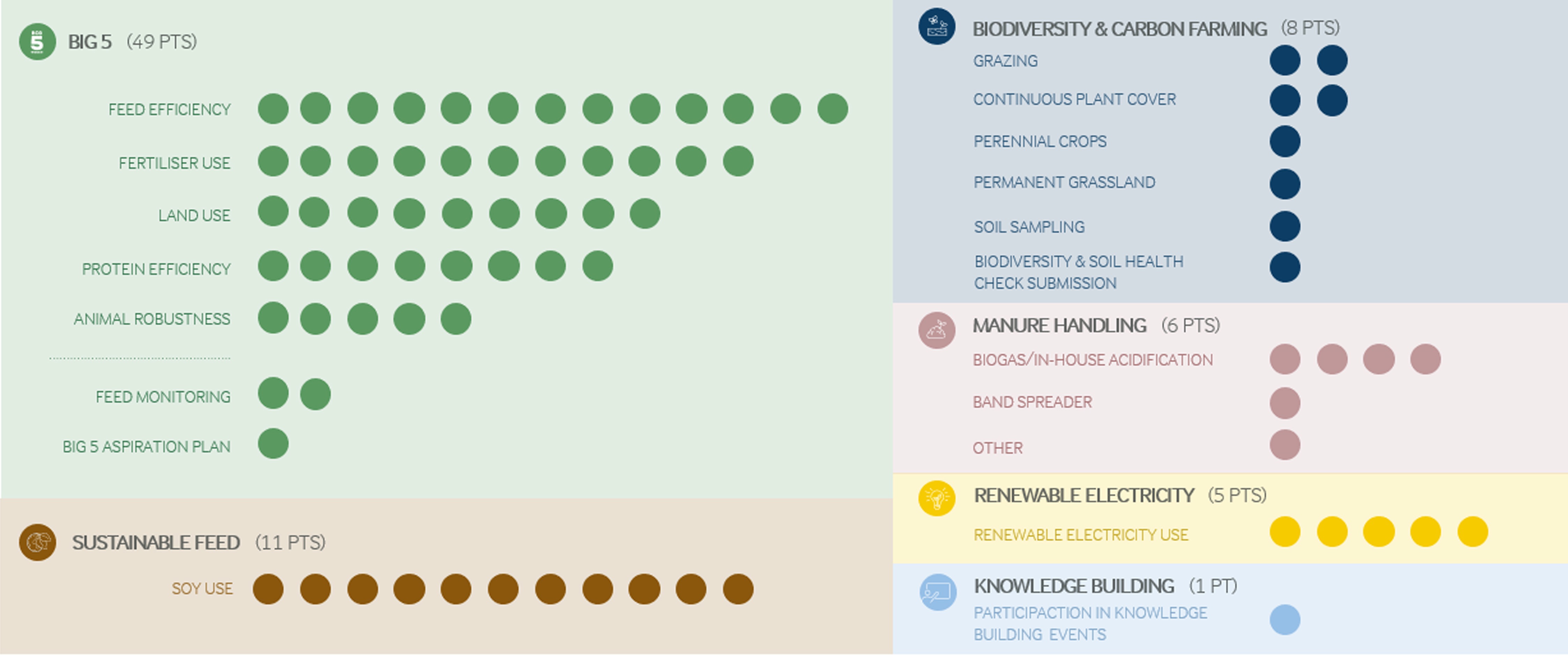
You can see which activities are included in the model and how many points they are worth in the picture below.

The activities that we’ve included in the model are based on our annual FarmAhead™ Checks and consultancy from external experts. We’ve included the activities that we’ve identified as the potentially most impactful, feasible and cost-efficient for our farmer owners to lower their farm’s carbon footprint and improve protection of nature and biodiversity.
Farmers can currently earn up to 80 points. As methodologies and scientific knowledge develop, additional activities may be added to the model.
The model is designed to reward farmers with up to 3 eurocents per kilo milk from the model plus 1 eurocent per kilo milk for taking part in the annual climate check as part of their monthly milk payment.
Why we've introduced the model
We are proud of being part of the dairy industry and bringing nutritious and tasty dairy to the world, but we also acknowledge that dairy production emits CO2e and contributes to climate change. As one of the world’s largest dairy producers, we have a responsibility to do our part in reducing our negative impact on the climate and the nature surrounding our farms.
Most of the dairy industry’s greenhouse gas emissions happen on farm. Here at Arla, our target is to reduce CO2e emissions from milk and whey by 30.3 per cent per kilo milk by 2030.
That’s why we’ve created FarmAhead™ Incentive. To reward our farmer owners for their work to reduce their climate footprint and improve protection of nature and biodiversity. Simply put, the more they do the more they are paid for their milk.
Q&A about Arla’s FarmAhead™ Incentive model
How does Arla’s incentive model work?
The FarmAhead Incentive model is a points-based model that rewards selected past and future on-farm actions related to climate and environmental performance — and includes a range of options for farmer owners to choose from.
Each activity corresponds to a number of points, and each point is linked to a financial payment reflected in the milk price. Activities with higher estimated potential to contribute to improvements in climate and nature are allocated more points — and therefore a higher financial incentive.
How are farmers rewarded points for their activities?
Farmers are awarded points for activities that can contribute, some directly and some indirectly, to reducing greenhouse gas emissions on farm and supporting improvements in areas such as nature and biodiversity.
In total, there are currently 19 areas (referred to as levers) in which farmers can earn points (these are illustrated below). At present, up to 80 points are available, but we expect to build more points into the model over time, for example as new technologies and data become available.
Each farmer selects the activities that are most relevant to their farm. In some cases, farmers may need to choose between activities, and it is therefore not expected that all farmers will reach the maximum number of points across the current levers.
Points are awarded based on data from the annual climate check, as well as additional activities that are registered and documented digitally by the farmer. Levers with higher estimated potential to contribute to reductions in environmental impact are allocated more points.
For some farm management levers, farmers can earn points within a defined range over time through continuous improvements. For example, a farmer can earn between 1 and 13 points for feed efficiency, depending on the amount of milk produced per unit of feed.
It is also important to note that not all levers have a direct impact on greenhouse gas emissions. For example, the model rewards participation in knowledge-building activities. While these activities do not in themselves reduce emissions, they are considered to support the farmer’s ability to implement relevant on-farm changes over time.

Why did you create the FarmAhead™ Incentive Model?
We are proud of being part of the dairy industry and bringing tasty dairy to the world. At the same time, we acknowledge that dairy production results in greenhouse gas emissions and contributes to climate change.
We believe it is possible to reduce emissions associated with dairy production, and we have set a target to reduce CO2e emissions from milk and whey by 30.3 per cent by 2030, compared to a 2020 baseline.
The FarmAhead™ Incentive is designed to support and reward farmers for implementing actions that can contribute to reducing greenhouse gas emissions on farm.
What are the most effective activities that farmers can take to reduce their climate footprint?
Based on the data from our annual climate checks, we have identified five activities that we currently believe have the biggest potential to reduce a dairy farm’s carbon footprint along with being some of the more feasible levers for farmers to do. We call them the ‘Big 5’. They are:
- Feed efficiency (More milk per feed input): A cow’s feed has a big influence on how much milk it produces. Feeding the cow with the right feed and in the right amount will optimize the amount of milk produced. When the climate footprint is allocated to more kilos of milk, the climate impact per kilo of milk will be reduced. Feed efficiency can also be expressed by keeping milk yield with use of less feed, which will lead to production of less feed. Optimizing feed efficiency requires a combination of smaller activities, rather than one clear strategy and will be individual from farm to farm. It is a constant balancing act of not feeding too much and not too little of the right blend of nutrients, to produce the best performance. Farmers can, for example, improve feed efficiency by focusing on diet composition (monitoring feed quality) as well as minimizing feed losses (from harvesting through storage and feeding).
- Fertiliser use (Reduce nitrogen surplus from feed production): All Arla farms will generate manure and most of this will be applied back to the ground as fertilizer for crop production. The manure is an extremely valuable resource, but it also results in nitrogen emissions. The amount of emissions depends on how the manure is stored and how and when it’s applied to the fields and what crops are grown. Where manure can't provide all of a crop’s nutrient requirements, mineral (artificial) fertilizer is used to supplement the nitrogen and other nutrients that are required. Applying additional fertilizers to the soil also results in greenhouse gas emissions (nitrogen). Optimal use of the nitrogen content from manure will reduce the need for commercial fertilisers and thereby also the total gross application of nitrogen.
- Land use (Better crop yields): Farmer owners utilize some of their land to produce feed for their cows. Optimizing and improving the crop yield used in cows’ feed, will enable a more efficient use of land. This lever is connected with fertilizer use, as crops need nutrients to grow and if fertilization is not optimized, the crop yield will be affected, and thereby more land is needed to produce the same amount of feed. Land use is also connected to feed efficiency as better feed efficiency reduces the need for feed and thus the land needed for feed production. Farmers can improve land use via precision farming to make the most of productive soils and direct the fertiliser where it can achieve the most payback. Another possibility is to choose crop varieties that provide a higher nutritional yield.
- Protein efficiency (Reduce protein surplus in feed ration): Cows need protein to stay healthy and produce milk but, like humans, cows excrete unnecessary protein, causing unnecessary CO2e emissions. Homegrown protein sources and bought-in protein concentrates are efficient ways of delivering additional protein to a cow in a small package. Carefully balancing the right amount of protein that the cows need will, in most cases, lead to better utilization of protein by the cow and limit the protein in the cow’s feed, resulting in less nitrogen being excreted. Farmers can, for example, improve protein efficiency by optimizing protein levels in the feed and optimizing feeding plans.
- Animal robustness (Healthy cows): Cows that live a long and healthy life will produce more milk over their lifetime. A longer lifespan means that the CO2e footprint of the cow, including the share that comes from heifer breeding, is distributed over a longer period and a larger milk quantity. When it no longer produces milk, a healthy dairy cow is used for production of beef, which leads to a lower footprint on the milk as part of the footprint is allocated to the beef. Farmers can improve animal robustness by maintaining barns, tracks and grazing areas to support good animal health as well as closely monitoring the cows’ health.
Why do you reward both past and future activities?
The FarmAhead™ Incentive model rewards both current and future activities and includes levers that are relevant for the different farm systems in the Arla cooperative. Farmers are rewarded for past activities, because these have contributed (directly or indirectly) to lowering Arla's total CO2e emissions through the years, and it’s important that these activities will continue.
How much money will be earmarked to incentivizing climate activities?
Farmers receive 1 eurocent per kilo of milk for submitting Climate Check data, which is a prerequisite for participating in the FarmAhead™ Incentive. The model is designed to reward farmers with up to 3 eurocent per kilo milk. That may seem like a small amount, but based on Arla’s owners’ milk volume in 2021 and the one eurocent that farmers will receive for submitting their Climate Check data, it corresponds to 500 million euro being earmarked for rewarding on-farm climate and environmental activities. However, we don’t expect it to be possible to reach the maximum amount of points, because each farmer will have to choose the activities that make most sense on their farm. In the first full year, at least 270 million euro (based on the total milk volume in 2021) is expected to be distributed through the monthly milk price based on what the farmers are doing on the 19 levers in the model with an estimated average of 39 points scored in the model in the first full year.
Where does the money for the FarmAhead™ Incentive Model come from?
From the outset, the model is funded through the raw milk value, in line with how Arla has funded similar incentives, such as the Climate Check Incentive. Over time, commercial activities related to Arla farmers’ climate and environmental actions are expected to contribute additional value to Arla and the milk price.
We consider that rewarding farmer owners for their actions can help communicate to customers and consumers how a share of the price paid for products linked to climate and environmental initiatives may support farmers. Payments to farmers are based on the number of eligible activities they implement within the model.
The FarmAhead™ Incentive is designed as one of several elements supporting the overall milk price.
How do you assess whether the incentive model can contribute to CO2e reductions?
The levers included in the FarmAhead™ Incentive are based on data from our Climate Checks and input from external experts. The levers are designed to encourage activities that have been identified as having a high estimated potential, while also being feasible and cost-efficient for Arla’s farmer owners. These activities relate to reducing greenhouse gas emissions on farm and supporting improvements in areas such as nature and biodiversity, in line with our target to reduce CO2e emissions from milk and whey by 30.3% by 2030, compared to a 2020 baseline.
Feasibility is assessed based on factors such as technological maturity, availability and the potential to be implemented across farms. Outcomes will vary from farm to farm, and some farmers may achieve larger emission reductions or improvements than others. If a farmer focuses on activities that do not directly affect greenhouse gas emissions, such as biodiversity or knowledge-building activities, this would not in itself result in CO2e reductions.
The model has been reviewed by agricultural experts from SEGES, who assessed that it has the potential to contribute to reductions in greenhouse gas emissions per kilo of milk produced on average across Arla’s owner farms.
How many points would an individual farmer need to achieve in relation to Arla’s target of a 30.3% reduction in CO2e emissions from milk and whey by 2030?
It is not possible to say exactly. The CO2e reduction target is set at company level for Arla, rather than for individual farmers, and the level of contribution will vary between farms.
The FarmAhead™ Incentive is designed to support actions that can contribute to reducing average greenhouse gas emissions per kilo of milk. However, there is no direct correlation between the number of points achieved and the level of CO2e reduction.
Some levers do not have a direct impact on greenhouse gas emissions. These are included because they can support the implementation of relevant on-farm practices over time, for example through participation in training or knowledge-sharing activities. Other levers relate to improvements in environmental areas beyond greenhouse gas emissions, such as nature and biodiversity.
Can you trust the data that the farmers put into the model?
Part of the data that the farmers are awarded points for comes from our annual climate check, while the remaining data is based on farmer reporting and uploaded documentation, for example certificates related to energy sourcing. To make sure that the climate check data is reliable, we have put the following measures in place:
- Climate Check advisors sense check: As part of the annual Climate Check process, external advisors review the farm data submitted by the farmer, comparing it with previous data and working with the farmer to correct potential errors such as typos, missing data or other inconsistencies.
- Outlier check: The external climate check advisor submits data to Arla for calculation and data set compilation, and any data points that differ considerably from previous entries or that are statistically or biologically implausible – will be highlighted to the external advisor. If the advisor cannot find the mistake, the Climate Check is forwarded to Arla to be checked.
- Final dataset evaluation: Once data collection for the annual Climate Check is completed, Arla reviews the full dataset to identify potential inconsistencies or missing information.
- External review by Ernst & Young: External review by Ernst & Young: The final Climate Check results are subject to external assurance as part of Arla’s group audits. Further details can be found in the Reasonable Assurance Statement for Arla’s ESG reporting in our Annual report (page 146).
For levers where farmers self-report their activities, internal verification processes are in place to help identify potential irregularities. These checks are carried out on an ongoing basis.
How often will the points be re-calculated?
Data from the Big 5 and feed-related categories is sourced from the Climate Check. This data is therefore recalculated on an annual basis. Data for other levers can be recalculated quarterly, meaning that farmer owners can update their information and have points reflected from the following quarter if their status on these levers changes.
When will the incentive be paid to Arla farmers?
The incentive is included in the monthly milk price payment, provided that the farmer has participated in the annual Climate Check. The milk price varies on a monthly basis, while the FarmAhead™ Incentive is set at 0.03 eurocent per kilo of milk per point achieved, in addition to 1 eurocent per kilo of milk for completing the Climate Check. Based on data from the Climate Check, the incentive points will be recalculated annually. In addition, farmers can upload documentation for additional activities during the year. Points related to these activities are then reflected from the following quarter.
Will farmer owners be rewarded based on carbon footprint per kilo of milk?
As part of the annual Climate Check, Arla farmers have their individual CO2e levels assessed. However, the FarmAhead™ Incentive does not reward farmers based on their individual CO2e level.
A key principle in the development of the model has been to ensure that it is applicable across different farm types. The FarmAhead™ Incentive therefore focuses on rewarding actions within defined farm management areas that farmers can implement in practice. These actions are selected based on their potential to contribute to reducing greenhouse gas emissions on farm and to support Arla’s overall target of reducing CO2e emissions from milk and whey by 30.3% by 2030, compared to a 2015 baseline.