From 1 June, DMK Group and Arla Foods have merged. Read the press release

Our approach to health

Our approach to health

Our aspiration

Good food choices make life better. Yet too many people lack the access, knowledge or inspiration to make them. We want to help change that.

The products we make and actions we take can create lasting value for consumers and society.

As one of the world’s strongest dairy cooperatives and the most popular dairy brand in Europe, we are committed to use our position to help enable good food choices that make life better. 

Our Health Strategy

Through our products

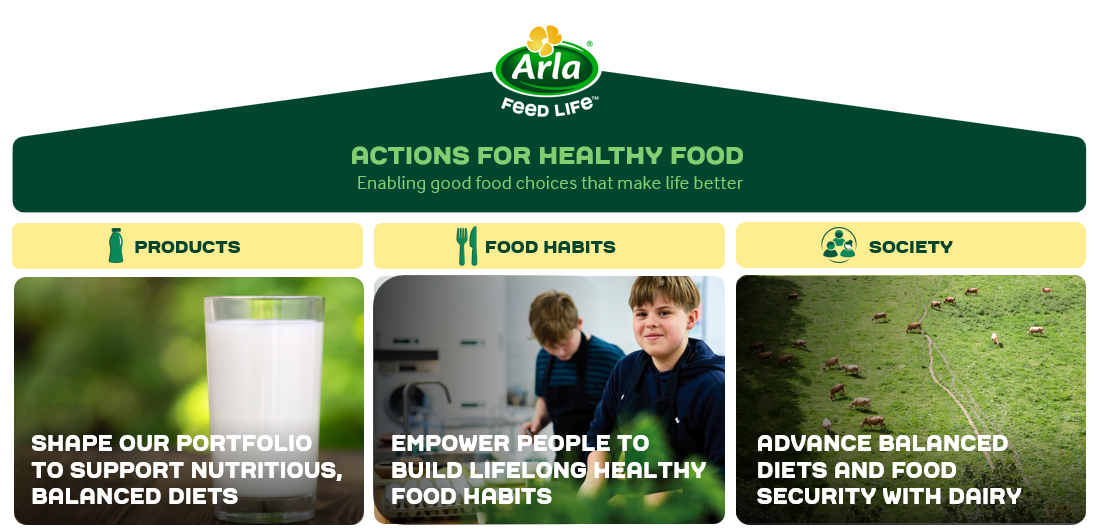
Shape our portfolio to support nutritious, balanced diets

The products we make are where we have the most direct opportunity to contribute to people’s lives. We want to provide a portfolio that increasingly supports nutritious and balanced diets throughout life, from childhood to older age.

We will continue to develop our portfolio in line with consumer needs and nutritional science, focusing on nutritional composition, natural ingredients and we will accelerate research and innovation in key strategic health areas. We are transparently reporting our progress annually using Health Star Rating.

Shape our portfolio to support nutritious, balanced diets
Through building healthy food habits

Empower people to build lifelong healthy food habits

Good food habits play an important role in lifelong health and wellbeing. We want to help people eat well and build healthy food habits throughout life, with a particular focus on the next generation.

Through our products, brands and activities, we help people build the knowledge, skills and confidence to develop good food habits. We work with customers, societal stakeholders and other partners to help make good food choices easier and contribute to healthier food habits in society.

Empower people to build lifelong healthy food habits
Through engagement in society

Advance balanced diets and food security with dairy

Improving public health requires action across society. We believe this calls for collaboration between businesses, governments, primary and secondary sectors, researchers, NGOs and other organisations to give more people the access, knowledge, skills and confidence to make good food choices.

We advocate for the recognition of dairy’s role in nutrition and food security and work with partners to support policies that enable nutritious and balanced diets. We also drive research and scientific collaboration to strengthen the evidence and understanding of dairy’s role in healthy and balanced diets and food systems

Advance balanced diets and food security with dairy

Our Health Strategy targets 2030

We have 5 targets towards 2030 to measure our impact on people’s health.

Note: Arla’s targets does currently not include DMK Group, which Arla merged with in June 2026. An assessment of DMK portfolio is planned for 2027-2028.

80% of our branded sales volume meet Health Star Rating 3.5 or above
44% of consumers across our main European markets agree that Arla makes it easy to eat healthily
Our key strategic health areas grow faster than Arla overall.
The volume of our salted products that are compliant with WHO’s sodium benchmarks is increased by 40% from a 2026 baseline.
70% of our sweetened portfolio contains no more than 4.5 g of free sugars per 100 g, and 90% of our sweetened portfolio contains no more than 6 g of free sugars per 100 g.

Health target methodology

80% of our branded sales volume meet Health Star Rating 3.5 or above (by 2030)

We measure the nutritional quality of our portfolio using the external Health Star Rating system, that rates products from 0.5 to 5 stars based on their nutritional composition. The more stars, the stronger the nutritional profile of the product.

Our 2030 target is for 80% of our branded sales volume to achieve a Health Star Rating of 3.5 or above, a rating considered a healthy choice by the Access to Nutrition Initiative (ATNi).

Our performance against Health Star Rating (HSR):

Year

Share of sales volume covered by our target*

Number of product recipes assessed

Share of sales volume HSR ≥ 3.5

Average HSR by sales volume

Baseline 2024

89%

1579

75.9%

3.74

2025

95.5%**

1567

79.5%

3.77

We assess products in each category using the Health Star Rating methodology. We then use sales volumes to calculate the overall share of our branded portfolio that achieves a Health Star Rating of 3.5 or above.

By category (2025)

≥ 3.5 HSR

Milk and milk powder

100%

Yogurt, fermented & desserts

98%

Milk-based beverages

94%

Cheese

53%

Cooking

5%

Butter & spreads

3%

*The target covers Arla’s own brands and products produced by Arla under our strategic partnership brands Starbucks®, Milka®, Kraft® and Galaxy® , across all markets. It excludes private label products and industry and bulk products where the final composition or use is not under Arla’s direct control, as well as infant formula products, food for infants and supplementary formulas for young children which are outside the scope of the HSR system.
Performance is measured by sales volume, reflecting the amount of product sold rather than its monetary value.

**We continuously work to improve our product recipe data for reporting purposes. Our current reporting covers 95.5% of the sales volume within our target. The remaining 4.5% is not included because the data is not yet sufficiently robust. We report on our progress in our Annual Report, and our process for this is validated by EY.

Did you know?
A product with a Health Star Rating of  3.5 stars or above is considered a healthy choice by ATNi (Access to Nutrition initiative), an independent global nonprofit organisation that assesses and benchmarks food companies on their contribution to healthier diets and improved nutrition.
Arla has consistently improved its position in ATNi’s ranking of the world's 30 largest food and beverage companies, from #14 in 2016 to #3 in 2024.  

44% of consumers across our main European markets agree that Arla makes it easy to eat healthily (by 2030)

Enabling good food choices is an important part of our ambition to support healthier food habits. Through our products, brands and food inspiration activities, we want to build knowledge, skills and confidence to help people eat well.

Our 2030 target is for 44% of consumers across our six main European markets to agree that Arla makes it easy to eat healthily.

The target is a combined target across our six main European markets. We measure progress through our consumer brand tracker, which regularly surveys consumer perception in the UK, Sweden, Denmark, Germany, Finland and the Netherlands.

In addition, we track if people believe that Arla has healthy and natural products, and that Arla contributes to healthy eating habits among children and young people. We do not have targets for these data points, but we monitor them to evaluate our overall progress.

Our key strategic health areas grow faster than Arla overall (by 2030)

We are making health a stronger driver of future growth, increasing its importance within our overall business. The share of our portfolio that meet Health Star Rating 3.5 or above has grown over the past years and it’s our ambition that our key strategic health areas continue to grow faster than Arla overall.

We will update our strategic health areas in 2027 to align with identified consumer health and nutrition needs, as well as long-term trends within health. We will drive research, innovation, investment and commercial focus towards products that support these, reflecting both consumer demand and our strategic commitment to health.

2030 target on salt

Our 2030 target is to increase the volume of our salted products that are compliant with WHO’s sodium benchmarks by 40% using 2026 as the baseline.

The target covers Arla’s salted branded portfolio, which accounts for approx. 22% of our total branded portfolio. It includes products produced by Arla under our strategic partnership brands. For the salt target, this includes Kraft® products. Private label and industry products are excluded.

To achieve this targets, we are reducing salt across our branded portfolio both by improving the recipes of existing products and by developing new products that meet our targets.

2030 target on sugar

Our target on sugar is twofold:

  1. By 2030, 70% of our sweetened portfolio contains no more than 4.5 g of free sugars per 100 g.
  2. By 2030, 90% of our sweetened portfolio contains no more than 6 g of free sugars per 100 g.

The target covers Arla’s sweetened branded portfolio, which accounts for approx. 15% of our total branded portfolio. The target includes partnership brands such as Starbucks®, Milka® and Galaxy®, but not private label products and industry products.

To achieve these targets, we are reducing free sugars across our sweetened branded portfolio both by improving the recipes of existing products and by developing new products that meet our targets.

Our positions

Our position on salt

About salt

The World Health Organization recommends that adults consume less than 5 grams of salt a day (approximately one teaspoon). However, many people worldwide consume substantially more salt, leading to a global average of approximately 11 g of salt per day.

Reducing salt intake is an important public-health priority and considered one of the most cost-effective ways to improve overall health in the population.

Arla’s position on salt

We support WHO’s efforts to reduce salt and we want more of our salted products to comply with WHO’s sodium benchmarks.

However, salt is important for the taste, texture, quality and safety of many dairy products, particularly cheese. Reducing it is therefore not always straightforward. We believe salt reduction should happen gradually and be adapted to the individual product.

  • Products that are not considered a part of our salted products
    • Milk, fermented milk products, yoghurts and dairy drinks are typically low in salt.
  • Products that are considered part of our salted products
    • Cheese is a significant source of salt, which is essential for flavour, texture, moisture control, microbial stability and preservation.  
    • Processed and specialty cheeses may contain higher salt levels than other types of cheese due to the use of emulsifying salts.  
    • Butter and spreads contain less salt than cheese and generally contribute less to salt intake because they are consumed in smaller amounts. 

Our commitment on salt

Our 2030 target is to increase the volume of our salted products that are compliant with WHO’s sodium benchmarks by 40% using 2026 as the baseline. 

The target covers Arla’s salted branded portfolio, which accounts for approx. 22% of our branded portfolio. The target includes products produced by Arla under our strategic partnership brand Kraft® , but not private label products and industry products.

To achieve this targets, we are reducing salt across our branded portfolio both by improving the recipes of existing products and by developing new products that meet our targets.

Arla’s commitment does currently not include DMK Group, which Arla merged with in June 2026. An assessment of DMK portfolio is planned for 2027-2028.

Our position on sugar

About sugar in dairy products

Sugar occurs naturally in milk as lactose, while free sugars can also be added to dairy products. Free sugars include sugars added during production, as well as sugars naturally present in ingredients such as honey, syrups, fruit juices and fruit juice concentrates. Naturally occurring lactose in milk is not considered a free sugar.

Reducing free sugars intake is an important part of a healthy, balanced diet. The World Health Organization recommends limiting free sugars to less than 10% of total daily energy intake and suggests a further reduction to below 5%.

Arla’s position on sugar

We support the WHO recommendation to limit free sugars. Our approach is to gradually reduce free sugars in existing products while ensuring that new products meet Arla’s targets for free sugars.

Our products containing free sugars or low- and non-caloric sweeteners are mainly fruit and flavoured yogurts and milk-based beverages. Sweetened products account for 15% of our branded portfolio, including products produced by Arla under our strategic partnership brands Starbucks®, Milka® and Galaxy®, but not private label products and industry products.

Arla uses low- and non-caloric sweeteners for products that aim to help consumers to reduce their intake of added sugar. However, generally, we aim to avoid low and non-caloric sweeteners when possible.

We do not use low- and non-caloric sweeteners in products specifically targeted for children. This reflects a precautionary approach, as scientific evidence on the long‑term health effects of sweeteners in children remains inconclusive.

Our commitment on sugar

By 2030, 70% of our sweetened portfolio contains no more than 4.5 g of free sugars per 100 g, and 90% of our sweetened portfolio contains no more than 6 g of free sugars per 100 g.

The target covers Arla’s sweetened branded portfolio which accounts for approx. 15% of our branded portfolio. The target includes partnership brands such as Starbucks®, Milka® and Galaxy®, but not private label products and trading.

To achieve these targets, we are reducing free sugars across our branded portfolio both by improving the recipes of existing products and by developing new products that meet our targets.

Arla’s sugar ambition does not currently include DMK Group, which Arla merged with in June 2026. An assessment of the DMK portfolio is planned for 2027–2028.


Our position on dairy fat

About dairy fat

Fat is a natural component of raw milk. Some dairy products contain saturated fat, which public health authorities generally recommend limiting as part of a healthy, balanced diet. WHO, for example, recommends limiting saturated fat to no more than 10% of total energy intake.

At the same time, scientific understanding of dairy fat continues to evolve, including growing research into how the health effects of saturated fat may depend on the food source and the overall food matrix.

Arla’s position on dairy fat

We support public food-based dietary guidelines. Through our food inspiration activities, we encourage high-fat dairy products to be used in balanced and moderate amounts, for example to add taste and texture to plant-rich meals.

Scientific knowledge of dairy fat and its role in health continues to evolve. We are committed to advancing the evidence base on whole dairy foods and actively support research that deepens understanding of dairy foods, dairy fat and their role in a balanced diet.

Our commitment on fat

We aim to ensure that our branded products with a higher fat content when possible also provide meaningful amounts of other nutrients naturally found in milk. The level of dairy protein in a product often reflects the levels of nutrients such as calcium, iodine, phosphorus, potassium and vitamins B2 and B12. The exception is butter and spreads, where their naturally high fat content means this principle cannot be applied.  

Policies related to our Health Strategy

Responsible marketing to children

Children can be particularly influenced by marketing, which is why we believe they deserve additional protection. At Arla, we are committed to marketing our products responsibly and transparently, with additional safeguards when our communications are directed to children.

When marketing to children under 18, we commit to:

  1. Only promote products with a Health Star Rating of 3.5 or above.
  2. Be clear and responsible in our communications, and never exploit children’s inexperience or mislead them about the benefits of a product.
  3. Support positive behaviours and the role of parents and caregivers, and never encourage children to persuade adults to buy a product for them.
  4. Place our marketing responsibly, avoiding media content that is inappropriate for children.
  5. Make commercial content clear, including when we work with influencers or content creators.

For children under 13, we apply additional safeguards, committing to:

  1. Only use characters and celebrities that appeal to children with products that have a Health Star Rating of 3.5 or above.
  2. Not use influencers or content creators to market to children under 13.
  3. Not place products in children’s programmes for the purpose of promoting sales.
  4. Only promote products or brands in primary schools when this is requested or agreed with the school.
  5. Protect children’s privacy, including requiring parental or guardian consent when collecting and using personal data.

Our approach follows applicable national legislation and is informed by recognised international standards and responsible marketing commitments.

Read our full Responsible Marketing Policy.

Responsible micronutrient fortification

A healthy, balanced and varied diet is generally the best way to get the nutrients we need. However, some people may not get enough of certain vitamins and minerals through their diet. In these cases, fortification, where specific vitamins or minerals are deliberately added to foods, can help contribute to adequate nutrient intakes.

Guided by WHO international guidance on fortification, Arla has these principles for fortification:

  1. Good nutritional quality comes first. We only fortify products with a Health Star Rating of 3.5 or above, unless national legislation requires fortification.
  2. There should be a clear nutritional need supported by relevant data on nutrient intake and the risk of deficiency in the population the product is intended for.
  3. The amount should be appropriate. The level of fortification should make a meaningful contribution to nutrient intake without creating a risk of excessive intake, taking into account other sources of the nutrient in the diet.

Read our full Micronutrient Fortification Policy.

Responsible product labelling

Clear and accurate food labels help people understand what they are buying and make informed choices about the foods they eat. Nutrition information and health and nutrition claims can help make those choices easier.

Arla is committed to providing clear, accurate and relevant information on our packaging, in line with national legislation and dietary guidelines.

For front-of-pack nutrition labelling, our principles are that it should:

  1. Be easy to understand for consumers in the local market.
  2. Help people make informed choices by providing useful nutrition information or guidance.
  3. Be applied consistently across products in markets using the labelling system.
  4. Follow national requirements and be aligned with national dietary guidelines.

There is currently no single global front-of-pack labelling system that Arla considers suitable for all our markets. We therefore allow relevant local systems that meet these principles.

On the back of our packs, our principles are to:

  1. Provide the required nutrition information clearly and in line with local legislation.
  2. Provide information about calcium in relevant products, as milk naturally contains calcium.
  3. Show reference intake information when vitamins or minerals are highlighted on the pack, and where relevant and possible in other cases.
  4. Provide nutrition information per serving where relevant, to help consumers understand the nutritional content of the amount they typically consume.
  5. Use consistent serving sizes when nutrition information is provided per serving.

We also take a responsible approach to nutrition and health claims. We only use claims that meet our nutritional and regulatory requirements and aim for claims to be meaningful and easy for consumers to understand.

Read our full Arla Foods Labelling Policy.